I just finished the third tome in Simon Gray's Smoking Diaries journals, The Last Cigarette (2008) and am inspired to write my own stream of consciousness memoirs, full of wit, self-deprecation and unintended wisdom. Unfortunately for me, my powers of concentration are already severely hampered, most pressingly by a lack of adequate vocabulary to write an articulate sentence. It starts well. Another strike against my plans to reach memoir notoriety is that a friend is due to come by in twenty minutes or so to take me out for a drink in compensation for being unceremoniously ditched at the last minute by a man I wasn't that interested in in the first place. Regardless, the ego suffers and requires to be surrounded by attractive people in overpriced bars. So this Grayan attempt at self-biography is also a time killer so that I am not forced to look at myself yet again in the mirror and comment, inwardly, though sometimes outwardly- like a policeman on a loudspeaker to a deranged man barricaded in a house- on the state of my hair, on the speed at which my face is becoming 'mature', at the rate at which my body is losing muscle tone. But, perhaps here I rejoin Gray, who in writing about all of his faults and weaknesses avoided actually having to do anything about them. To write, to expose, to expostulate is also to distance from, to nudge and wink at oneself in the mirror of the page (never ever its glass friend that has so long been an enemy).
This is what Gray does, dance around the pain of a subject before attacking it side on or sometimes not at all. That is something I love in his writing, sometimes bringing up a subject that he mentions in passing, the pain of it, and then it is gone, not to be written about again. An executive decision has been made. So, no, you will not get the details of being dropped on a Friday night and then spending infinite amounts of time with a pink flat iron. Those details remain my own.
Simon Gray died not too long ago. If I wasn't so lazy, I would open another window and look it up on Wikipedia but I assume if you are interested, you can do it yourself. It was not too long ago. Having finished the last of his memoirs, I am saddened by his passing. Hence the title of this blog post (writing 'blog post' causes an inner shudder) of which I am not even sure of the appropriate formulation, in fact I know I have misspelled in memoriam because it keeps coming up with a red line underneath it yet the alternate options are not the word I am seeking (memorabilia, memorandum) and this is exactly what I love about Simon Gray, the digressions and the willingness to expose the delicate undergarments of personal frailty, our weaknesses yet also our essential humanity.
I will miss your fine wit, Mr. Gray.
Showing posts with label book-ish musings. Show all posts
Showing posts with label book-ish musings. Show all posts
Friday, April 29, 2011

Saturday, February 12, 2011
Save some fur me

So.
I stayed up really late last night reading Bet Me (Jennifer Crusie, 2004) a romance novel that was chosen by my book club in honour of Valentine's day. I had been quite scandalized to be reading such a low-brow novel, and was quite furtive when ordering it from my local library (the librarian even seemed a little surprised when I came to pick it up, "celui-ci??" she asked holding up the blue hardcover with an image of plastic mule sandals and cherries. "Oui, oui, c'est pour moi," I answered hoping no one else noticed). All this to say that once I picked it up I could not put it down and that meant that my long list of Saturday errands had to be squeezed into a much smaller window of time.
It is always when I am in a hurry that everyone else around me s-l-o-w-s d-o-w-n-- . After trying on several pairs of black pants at Friperie Renaissance (yes, that counts as an important errand. My work colleagues are starting to rebel at seeing me in jeans day after day), I found a reasonable pair and with half an hour to spare, I went to stand in line. There was a sale on fur stoles that was inspiring the most frenzied excitement among my fellow shoppers. An elderly Asian gentleman encouraged me to get them while I could and at one checkout, a woman had a shopping cart full of black fur and was arguing with the teller. I imagine she was planning to make fur coats for all of her immediate family. I chose the other queue, where a new employee struggled with the cash register. He then started a long discussion with a buxom woman who was either returning a coat or wanting a discount. Next was an Indian woman who was buying two kids' books (what no fur stole?). Right, this should be quick, I thought, looking up at the clock. Then she paid with a fifty dollar bill and this started another long-ish moment with Newbie cashier finding his supervisor, his supervisor verifying the bill's authenticity, then Newbie slowly calculating the change for the purchase that could not have been more than 75 cents. I checked the other line. Fur Lady was leaning over the counter and pointing her finger. The man behind her in the queue was starting to sweat. I returned my attention to my queue, now two elderly ladies with small purchases (fur stoles, books, a picture frame). Right, moving right along. Newbie stapled the elderly ladies' receipts together and offered them a bag. I looked at the clock, time was slipping on and on. The woman in front of me, we'll call her Bleach-hair, moved up to the cashier (3 fur stoles, flimsy white skirt), then proceeded to pay for her purchase in nickels, pennies and quarters (the quarters were in a plastic bank roll which she struggled for what seemed like an eternity to open). I leaned on the counter, drummed my fingers, grinned madly to myself as I looked again at the clock. I was definitely late now. Then my turn. I thought, right, we'll show these people how to make a speedy purchase. But then I realized I had no cash and had to use my bank card which became inextricably stuck in my wallet. Much wallet wrestling ensued and the woman behind me (fur stoles, t-shirt) sighed.
That is what I get for reading romance novels!
Sunday, January 16, 2011
Houllebecq sucks, or why horny white men should not travel
Being the frank francophile that I am I try to keep up with the major cultural movements in France. Living far away and being primarily self absorbed in my own life, only the biggest waves make a ripple in my attention and therefore I miss out on most cultural phenomena coming out of the hexagon. Michel Houllebecq, France's literary badboy did make it on to my radar a few years ago (the guy actually won the Prix Goncourt this year) so I decided to read a book, see a movie, and see what was what.
I read Platforme (2001), and saw Les elements particulaires.
The film was shit. The book even worse (more on that later).
Then today, I read an interesting article on tattoo culture by Mark Greif (wait, the connection is coming), got curious about him (some literary guy out of NYC) and looked up some other things that he had written. I read a review he wrote in 2003 of Houllebecq's Platforme and it re-awakened all of my dormant ire and irritation. My feminist growl and literary snobbism were ready for a fight.
I had pretty much forgotten the plot line of Platforme and could only remember my feeling of revulsion and disgust when I finished it. Luckily for me, Greif does a quick summary of the book, to remind me what I hated about it. It goes something like this: whiny French guy, isolated from any meaningful relationship goes to Thailand to fuck Thai girls, does some of that, meets a wonderful French woman, who is perfect in every way (basically, is completely forgiving of his narcissist, self absorbed, bullshit and still puts out all the time to mutual orgasmic joy), moves back to France, and said girlfriend sets up a sex-tourism industry which helps gross, middle aged white folks go to the third world so that they can screw third world whores. Then a bomb goes off, the girlfriend dies and the French guy goes back to being a whiny asshole (which, consequently, he never stopped being). The end.
The feelings I have about this book resemble the vitriol I felt upon reading Un dimanche a la piscine a Kigali (Gil Courtemanche, 2000) quite a few years ago. I was so incensed upon finishing it that if it had belonged to me I would have ripped it in half. It is almost against my nature to do violence upon books but it was such crap that I could barely control myself. The plot there, if I remember correctly, was: white male protagonist in Kigali during the genocide, wanting to fuck some young, idealized stereotype of the "African woman" (is it possible that her name was Innocente? or wait, Gentille!), fucks her, she gets killed (we get a long description of her rape and her deciding to embrace it and enjoy it) and then some other people get killed. The end.
After reading it, I read a glowing review by Giles Foden, of whom I had previously thought good things. I haven't read another book of his since.
Can we not move past the image of woman, and the 'exotic' woman, more specifically, as a piece of ass? My feminist heart grows weary at the way the over-sexualization of women is so taken for granted, is so unblinkingly presumed that it doesn't even make the review pages.
I am tired just thinking of how to articulate my argument, how to couch it in words that don't raise the hackles of anti-feminist middle roaders. What is so plain to me, so obvious to the women around me, doesn't cause a ripple or a pause, not a parentheses, nor a hand scratching across an unshaven chin. It is an uphill battle. One that makes me, when the anger has run out, terribly sad.
Sunday, December 12, 2010
Cosmicomics

Just finished Cosmicomics (1965). I think Italo Calvino is my new favourite author. He rocks the Casbah, even in translation. I am tempted to learn Italian just so that I can read him in the original.
Cosmicomics is a series of stories based on theories regarding space and the universe. Example:
The more distant a galaxy is, the more swiftly it moves away from us. A galaxy located at ten billion light-years from us would have a speed of recession equal to the speed of light, three hundred thousand kilometers per second. The 'quasi-stars' recently discovered are already approaching this threshold. (The Light-Years)
And from this, Calvino creates a story, a wonderful, smart, audacious story. Wow.
Particular mention goes out to The Aquatic Uncle about the transition from water living creatures to land living ones, and to The Distance of the Moon, which is about a time when the moon passed super close to the earth and people would jump up to gather a cottage-cheese like substance from it's surface. It's about unrequited love. As a matter of fact, so is The Aquatic Uncle. Now that I am thinking about it, The Dinosaurs is truly fantastic as well, about the last dinosaur who lives with those who have replaced his species in the earth's evolution. Bittersweet.
In other news, I just spent ten minutes engrossed in a Youtube video-slideshow of Arnold Schartzenegger' s early bodybuilding days. Random.
Tuesday, November 16, 2010
Wolf Hall
Just finished Hilary Mantel's Wolf Hall (2009). I read it, all 600 plus pages of it because I am a sucker for a prize winner. It won the Booker last year and I am easily impressed by the glitz and glamour of posh writing prizes, especially those out of the UK.
I had been unsure about Wolf Hall because the only people I had seen reading it were men of a certain age on metros and trains. Men, whose reading taste I feared I would have little in common with; men with bellies starting to bulge from grey suits, watches heavy and shiny on hairy wrists; briefcases tucked between knees, maybe reading a hardback copy but definitely not one from the library. "It seems a man's book," I said to a friend but she assured me she had seen women reading it, too. So I got it out of the library.
In case you don't know, Wolf Hall is about Thomas Cromwell and his rise to power under the reign of Henry VIII and all those shenanigans with divorce and marriage and creating a new religion in which the king is top dog and not Rome. Pardon my lack of articulateness, I feel all the good words got used up in the book. It made me curious to read more of Mantel's work. Does she only do historical fiction? What about short fiction, say a novella?
It is, in my humble opinion, a man's book; politics, detailed history, kings, not much romance, power politics, and diplomacy. Interesting nonetheless.
In other reading news, I read Parrot and Olivier in America by Peter Carey which is a reworking of de Tocqueville's journey to the USA somewhere in the time of the French Revolution. It was great and reminded me yet again that I really must read Democracy in America (1835).
And now onto Cosmicomics that has finally come in for me from the library. Viva Calvino!
Saturday, October 9, 2010
If on a fall's afternoon a reader
Just finished Italo Calvino's If on a winter's night a traveller (1981). Wow. I have been curious about Calvino since I read an excerpt of a new translation of Cosmicomics in a magazine. At the time, I thought, "who is this guy?" the writing was so out there. I then did a half-hearted search for his works in a Renaud-Bray but could only find him translated into French and figured if I was going to read a translation, since my Italian isn't what it should be, I would rather read it in English.
It was in London, J- rummaging through her book collection, looking for something to give me for the return trip to Canada, that I saw his name again. If on a winter's night a traveller was my distraction during the long haul across the Atlantic, having found its way into my hands in a most circuitous way. I love books that come to me by way of accident, serendipity, coincidence. One of my most beloved finds was The Shah of Shahs by Ryszard Kapuscinski, that I found in a tiny, second hand bookshop in Havana on a sunny evening while L- and I searched for a reasonable restaurant. Anyone who has been to Cuba will know that a reasonable restaurant is hard to find.
Back to Calvino. If on a winter's.. is a reader's book. It is full of winks and nudges to the reader. In fact the main character, if he can be called so as he is addressed as 'you', is called 'the Reader'. His/your love interest is 'the Other Reader'. It is all twisted inside out. Stories within stories. Murders and plots and a grand scheme to put 'fakes' inside of books. I laughed out loud.
There is one fantastic scene where the 'you' is distracted from his mission of finding the conclusions to books by a young woman, who he starts to seduce. This is how Calvino describes the scene:
"With this, Sheila-Alfonsina-Gertrude has thrown herself on you, torn off your prisoner's trousers; your naked limbs mingle under the closets of electronic memories.
Reader, what are you doing? Aren't you going to resist? Aren't you going to escape? Ah, you are participating... Ah, you fling yourself into it, too... You're the absolute protagonist of this book, very well; but do you believe that gives you the right to have carnal relations with all the female characters?" (p. 219)
Pure, hysterical brilliance. Now I just have to get my hands on Cosmicomics.
Monday, July 12, 2010
You can bite me, Mr. Pip
It appears, from the the cover, to be quite promising: short listed for the Man Booker, winner of the Commonwealth Writer's Prize. Not only that but it came recommended. "You must read this book," said my aunt, pressing Lloyd Jones's Mr. Pip (2007) into my hands. Were my expectations too high, am I giving up too early (I admit, I am only about halfway through)? Am I really just a jaded and cynical book reader, hater of Paolo Coehlo and all that is simplistic and pure?
What, exactly is my problem with Mr. Pip?
Well, let me tell you.
First off, one has to be very, very careful in taking on the voice of a young woman of colour especially when one is not in fact a person of colour nor for that matter a woman. Lloyd Jones is neither. A tricky place to start considering the long and illustrious history of sexism, colonialism, oppression and patriarchy weighing on his shoulders. This does not seem to bother our dear Mr. Lloyd who has as a protagonist a quasi-pubescent girl from somewhere on a pacific island. Mr. Lloyd doesn't seem to see a problem in having a main character who is mind-bogglingly innocent and who seems to have grown up, in the nineties no less, completely isolated from any sense of global culture (what, they have generators and airplanes but no one's ever bothered to get a television?). I have been to some far flung villages, too. No running water, no cars or scooters, no doctors or candy, but the people were a lot more worldly than Mr. Lloyd's land of dopey islanders.
So that's a start, but to make matters worse, Lloyd contrives to have the story revolve around the last white man on the island. A strange and marginal character named Mr. Watts, who somehow becomes the local teacher during the beginnings of a civil war. Why this foreign yokel should become the teacher when all he does is pull his wife around in a cart, can only be explained because he is white, and therefore the holder of great wisdom. I kid you not. Of course, Mr. Watts is faux-humble and then reads to the kids, who admire him above all else and are ashamed of their parents, from Dickens' "Great Expectations". The kids of course (of course!) love the book, never having read one before themselves, and admire Mr. Watts even more. And friends, none of this is written with even a hint of irony, not a trace of neo-colonialist shame, not a smidgen of self-doubt. Mr. Watts is great. Everyone thinks so, except the parents and they are superstitious losers anyways.
The island's parents come into the school, one after the other, to share their own educational wisdom. This is of course Mr. Watts' idea and he looks on most benevolently. The stories they tell are sweet and innocent (ahhh, them native folks) and they are all crushingly embarrassed or shy or humble. Noble savage, anyone? The kids squirm in shame and I am left to wonder why the parents wouldn't just tell these stories at home or in their proper context rather than in the white man's school. Really!
Now, don't get me wrong. Some of my favourite authors are white men who have strayed too long in the tropics: Kapuscinski, Graham Greene, Bruce Chatwin, Paul Theroux. But their writing always has a sort of self-consciousness to it. Their characters may be self-important losers but the reader is made aware of the discrepancies, the fault-lines, the power dynamics, the fragility of being a white man in a non-white world. Mr. Watts, while sometime shown to be frail and at times a victim, remains a character without any sense (internally, from within the novel to externally, through Jones' prose) of power, responsibility, or sense of himself as a white man in a non-white environment.
Instead, everything is syruply straightforward. Island full of innocent native folk, wise and genteel white man educates island's children, everyone loves Great Expectations (hey, I had to read it in high school and found it so boring I couldn't get past the first twenty pages and bluffed my way through the exam), and then rebels come and ask, "who's this Pip character?'" because they've seen his name written on the beach. Yes, the rebels are stupider than the villagers, and that's saying something.
Mr. Lloyd, please. Give your characters some credit.
(to be continued and perhaps amended once I have actually finished the book)
Sunday, June 27, 2010
I heart Granta (For E.G.- bonne voyage)

Oh, Granta, how I love thee. How I salivate when I see you. How I want to hold you, flip through your pages, read your author summaries, pore over your photos.
I once told a friend that one of my fantasies was going to a garage sale and finding a whole bunch of Grantas but for really cheap, like 25 cents each so I could get all the ones I don't have, so I could be Granta-guaranteed for a year and a day. My friend looked at me like maybe I need to work on my fantasies.
Then another friend, who first started my Granta addiction, moved to Iqaluit where there seems to be endless supplies of Granta everywhere: lying next to dog sleds, rolling in the tundra, holding up houses, mopping up seal blood. In her abundant generosity, she started sending me issues that she found in the street or abandoned in bathrooms. Wipe off the blood stains and they are good as new. I think there is a tourism-marketing strategy that Nunavut could exploit here: Come to the North, you will have a good read!
Just read A. L. Kennedy's Story of my life, in Granta 105 and I want to jump at the sheer talent of the writing. Damn, it's good. Even Richard Ford, who normally I don't have much time for, is good in Granta (The Womanizer, Granta 40). And that one by Hanif Kureishi about being a loser in Pakistan. Oohhhh.
Saturday, May 16, 2009
Dawg gone

I am struggling through The Story of Edgar Sawtelle (David Wroblewski, 2008). It is a brick of a book at over 550 pages. The only reason I have persevered is that both my uncle and mother thought it was very good. My mum even encouraged me on the phone today, 'give it another fifty pages,' she said, 'and if you're still not into it, let it go.' Another fifty pages.
And it is not like the writing is bad. Far from it. The writing is quite good but more what old David is writing about. For those who haven't read it, it is about a family who raises dogs. That's it. They raise dogs and train dogs and help dogs be born and watch stray dogs at the edge of the woods and talk about dogs and pat their dogs and go for walks with their dogs and feed their dogs and reminisce about dogs. No kidding. One chapter was devoted to naming some new dogs. And they didn't even get particularly interesting names. Now maybe if I was crazy about dogs I'd really be into this.
I am not crazy about dogs ergo I am struggling with this finely written but infinitely boring book.
I'll give it another fifty pages.
Monday, May 4, 2009
Travel writing
Lately, I have been thinking about travel writing. I am reading a friend's book, Poets and Pahlevans: A journey into the heart of Iran (Marcello Di Cintio, 2006) and it is making me think of the craft of travel writing.
How does it actually happen? I picture a sweaty and tired traveller hunched over a rumpled notebook in a sparse hotel room, a naked bulb hanging from the ceiling, frantically scribbling with a runny ballpoint. Or maybe a laptop on a cafe table, high, louvred windows and incredible luxury at dirt cheap prices as the monsoons flood the streets outside. Iced coffee after iced coffee on lazy afternoons. The first is a furtive, private affair. The second a more romantic, colonial fantasy. Or is it more of a stream of consciousness thing? Self narration through mundane daily activities?
"I hailed a taxi, the dust at my feet softening the harshness of the sun-baked earth. A broken-down, applegreen car pulled up. There were already four customers squeezed into the front and back seats. My place was in the front seat, next to a young woman in a tight, sequined top and traditional African pagne. Her face shiny with sweat, she smiled and shifted over towards the gear shift. There is always room for one more. "
Or is it an act of memory? I am always impressed when I read that some writer spent six months in some unobtrusive place such as western Massachusetts or Ontario, writing and recollecting about travels in Mogadishu or Kazakhstan. I wonder what gets distilled through memory, new context and the need to get onto something new.
All to say, I am quite enjoying the book.
Sunday, April 19, 2009
The attraction of memoir is (dis)honesty
I have been thinking about writing lately. I am seeing if I can go from one who reads to one who writes. It is a humbling challenge especially when I read lines like "I was a young woman of occasional good looks" or references to childhood as the murky sea-floor while the world of adults happens up on the surface of the ocean (Nuala O'Faolain, Are You Somebody?, 1996). Now that is writing but then again, she was someone who dedicated her life to the literary way. I am just playing.
I have always thought to write about my family. If no one does it before me, I will write about the women who came before. Because of world wars, migration and Nazi ovens, my foray into the past can only go so far. In fact, the furthest I can get is my grandmother who died many, many years before I was even a thought. But my grandmother and my own mother are interesting enough in their own right to fill at least several hundred pages.
This is what I know about my grandmother: She survived the war. She was beautiful and blonde and jumped from a train on her way to a death camp. She loved to skate, something my mother, for all her effort, was never able to master. She had an affair with a well-known writer who demolished her in a short story. She was bossy and proud and smart. She was good at maths at the local gymnasium.
This is how I would recreate her:
-Summer in Poland, in a thin dress with washed out flowers on it, squinting maybe, as she looks across a field of dry grass. I would like to feel the ambition coursing through her veins, reaching into her hands, pushing down into her feet, putting her on edge. It is a small town.
-I would like to give a voice to her own survival. Everyone who survived did so through luck and finger-nails-scratching-the-dirt determination, through conniving and betrayals, and walking on when you really want to turn back. And then they all came here and pushed the horrors of what they'd seen and done far, far away. I would like her to speak. To speak with pride. To say out loud the inherent victory of "I survived" that wipes out any hint of shame.
-I would have her skating in fur-trimmed coat and warm gloves; laughing and looking like a cross between Ingrid Bergman and me. Maybe a cigarette between gloved fingers (let's make them turquoise) and that old fashioned, too bright, chalky lipstick from the fifties. Men watching as she glides past, her legs encased in stockings. Snow on eyelashes and laughter in frosty gusts.
Monday, April 6, 2009
Reading round-up
I found Chuck Palahnuik's Lullaby (2002) on the sidewalk a week ago. I read half and then gave up. I don't usually give up on books halfway through but there is so much good stuff to read out there and this book just wasn't it. Long on description, light on credible characters and a rather irritating obsession with some white girl rasta's shaved hoo-ha. Probably why it was on the sidewalk in the first place.
Before picking up Lullaby, I read Shakespeare by Bill Bryson (2007) of Notes from a Small Island fame. A quick and light read. Like a panini in an airport, it won't really fill you up but the grilled veggies are nice if expensive. This was a loaner so cheaper than a panini.
I am onto Amos Oz's To Know a Woman (1991), a pass-on from a friend trying to lighten her library. I am only a few pages into it but at least it is decent if somewhat depressing writing.
And finally, I picked up David Adams Richards's Mercy Among the Children (2000) at the second hand shop (I also picked up a plastic dump-truck). It has won many awards, sometimes a sign of good things.
What are you reading?
Monday, March 30, 2009
And now I can finish 'La strategie des antilopes'
I have finally finished Julia Alvarez's In the Time of the Butterflies (1994) and have but one word for you: mehhhhh.
Tuesday, March 10, 2009
Why I love public libraries
Oh public library, how I love thee.
I love the young, gangly teenagers who always hog the internet computers. I love the Sikh men at long tables, their laptops glowing and sometimes singing. I love the retired folks who doze in the sun near the newspapers. I love the students, huddled in their cubicles, at the back of the stacks. I love the children, coats askew, pushing and shoving at the check-out counter. I love the homeless man, large backpack at his feet, reading about dream analysis on a cold day. I love the librarians, especially the one from Rwanda who says 'nonante' for 'quatre-vingt-dix' and the other one who told me the movie I was taking out was a 'turnip'.
I love the displays of French poetry, romance novels, guides to writing, or Quebec winters, all tantalizingly exposed for the picking. I love the community newspapers, haphazardly stacked on little metal stands at the entrance, only some of which are in English or French. I love the free bookmarks advertising booksales for 1$ or less.
I love the stacks. I love the feeling of holding a piece of paper with a seemingly random jumble of numbers and letters that guides me to the book I want. I love the briskness in which I type a search into the computer monitor. I love finding a book in the 'New Arrivals' section that has been the talk of the town.
I love finding a DVD that wasn't there the last time or ordering a book that is at a library across town. I especially love the automated phone call telling me my requested book is waiting for me.
I love how the library is for everyone. Everyone is included and everyone belongs. I love how I have read many hundreds of pages of fiction, essays, graphic novel, and how-to books and haven't paid a cent.
Monday, March 9, 2009
A beginning- or why I want to read all Jean Hatzfeld's work
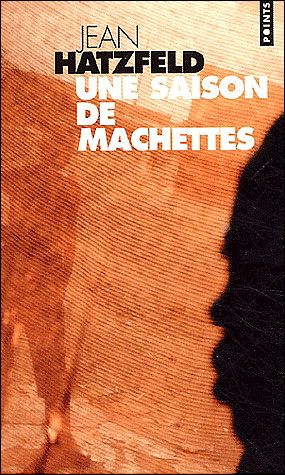
I have just finished Machete Season (Saison de machettes, 2003) by Jean Hatzfeld and I need to talk about it. It is an amazing and disturbing piece of writing. The second in a trilogy about the 1994 Rwandan Genocide, Machete is essentially a series of interviews with a group of perpetrators who all come from the same small region of Rwanda. The interviews take place in a prison where the men are being held for perpetrating genocide.
After interviewing the survivors from the area of Nyamata and writing a book about it (Dans le nue de la vie, 2000), Hatzfeld finds himself drawn to the perpetrators to try to understand how they lived the experience of systematically hunting and killing their neighbours everyday for over a month.
The answer is not pretty. The killers, who are at times grotesquely honest, show little insight into their actions. They are egotistical, self-centred and show no remorse, regret or sadness for the lives they have taken. They don't have nightmares. They are not mentally unstable. They are a group of men, sitting in prison, feeling bad for themselves, unwilling to explore within themselves the reality of the horror they have perpetrated. Disturbing stuff. I feel that in reading Machete, I have looked right into the darkest corners of the human soul. And what is most disturbing is how banal and normal killing can become.
I have been staring at people on the bus. We are all potential killers. I am feeling protective of my son.
I have started to read the third in the trilogy, La strategie des antilopes (2007, I don't think it has been translated into English yet), which is about life on the small hill community of Nyamata after the perpetrators are released from prison. The survivors and perpetrators are neighbours. This makes me want to scream yet I can't put it down.
Now, I want to read Eichmann in Jerusalem (Hannah Arendt, 1963) and Hatzfeld's earlier work on the war in Bosnia, L'Air de la guerre (1994).
I can't seem to get enough of this stuff. Why?
Subscribe to:
Posts (Atom)


